 NanoDetectorAI
About
NanoDetector enables near real-time monitoring of wildlife in exceptionally remote areas, providing timely insights into animal presence, distribution, and behavior. Using an ensemble of custom-trained Artificial Intelligence models to analyze camera trap photos on-device, NanoDetector can detect and classify animal by species and transmit these observations via satellite uplink to anywhere in the world.
The fully documented hardware implementation for NanoDetector is based entirely on inexpensive commercially available components, and the software and model weights are distributed under an open-source license. With the information provided here, anyone can build, configure, and deploy one NanoDetector or a grid of NanoDetectors to support research, wildlife management, or rangeland operations.
The trained model weights are published on Hugging Face:

The device design, firmware, training and evaluation code, and full documentation are on GitHub:
sheneman/NanoDetector
This tool was developed in association with the "Wildlife and Humans in Shared Landscapes" (WHISL) project. Learn more about WHISL.


Output
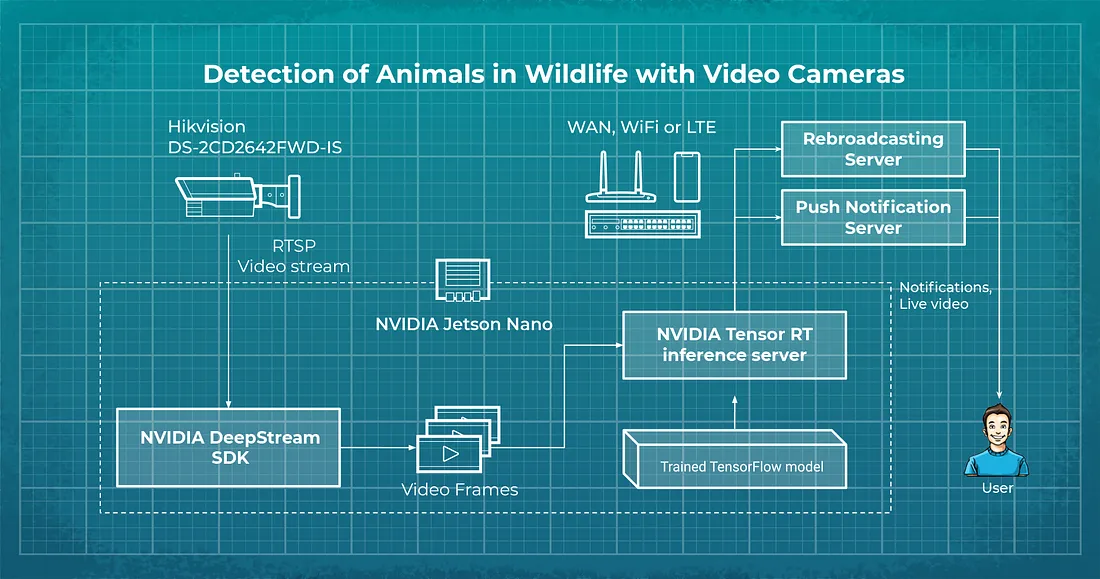
Each image captured by the trail camera is analyzed on the device by two models working together. MegaDetector locates animals, people, and vehicles in the frame, and the custom-trained NanoDetector model identifies the animal to species across 25 classes. Detections from rapid-fire camera bursts are consolidated into a single observation.
Because the images are interpreted on the device, only the resulting observations need to cross the satellite link — kilobytes of structured detections instead of gigabytes of photographs. The complete record, including the original imagery and annotated detections, is retained on an onboard SD card for retrieval during routine site visits.
Full per-species accuracy results, model limitations, and the evaluation methodology are documented in the evaluation report and on the model card.